

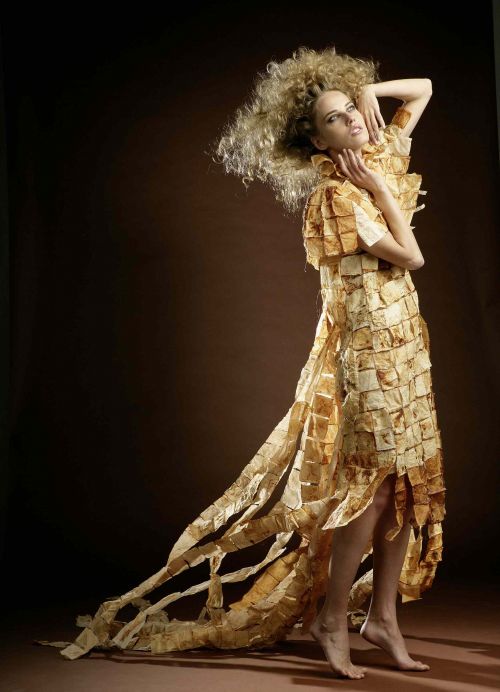
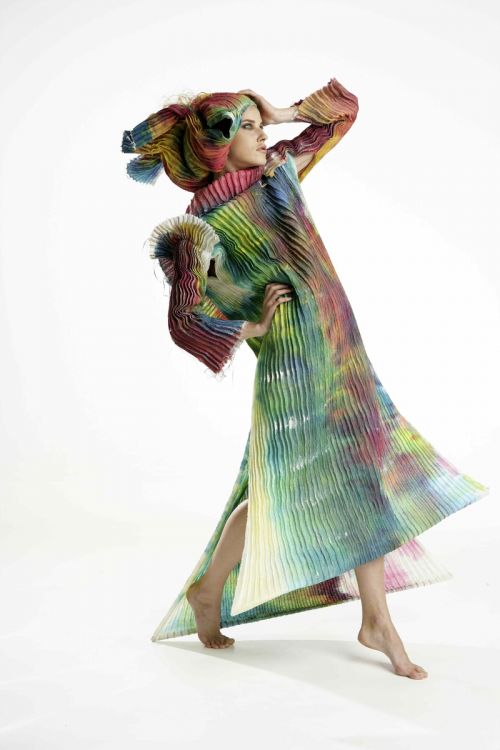
Performance with three pieces of Mascha Mioni's Art to Wear at the Musée du Quai Branly, Paris
Performance with three pieces of Mascha Mioni's Art to Wear at the Musée du Quai Branly, Paris
At the 8th International Shibori Symposium at the Musée du Quai Branly, Paris, in Nov. 2008, new creations of Mascha Mioni's Art to Wear are shown by the choreographer Micheline Lelièvre. Main piece of the performance is "The Rooibos Teabag Dress" made entirely of recycled bags of the South African national tea rooibos (redbush)."Here Comes the Sun" is a nine meter long painting on heavy silk, which is turned into a dress on stage.
A Call from Africa
Choreography: Micheline Lelièvre
Dance: Micheline Lelièvre, Lisiane Michel, Laura Tristan
Music: Philippe Pannier
Coordination: Ysabel de Maisonneuve
Program of the evening
7 minutes Videoclip "A Call from Africa" on youtube
go to post
artCore - Die Körperhülle in der Kunst
artCore - an association for furthering online-reports and presentations of art in the internet - writes on Mascha Mioni's art in the Aarberghus, Ligerz, Switzerland
"...
"...
In this group Mascha Mioni rerpresents "Art to Wear" and relates to the early works of Elsi Giaugue, from a time when this word-creation had not yet been invented.
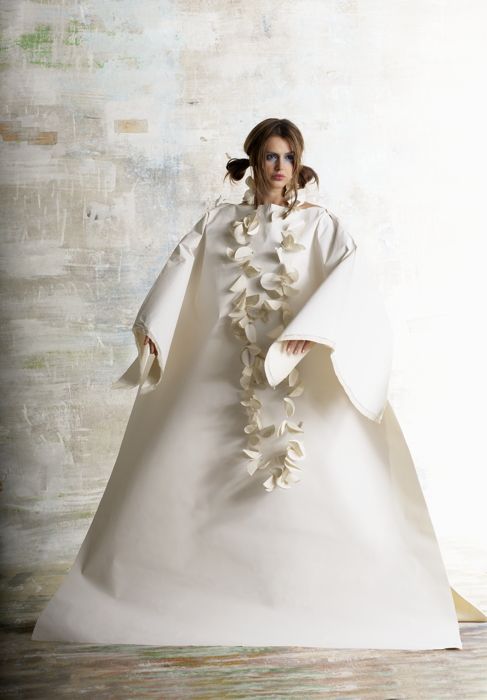
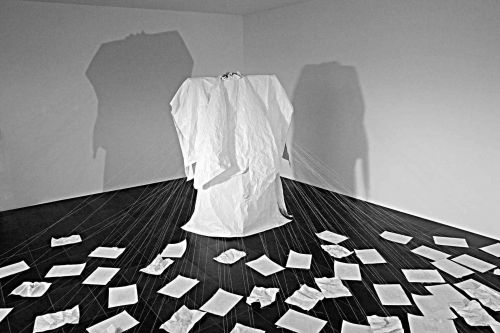
In the beginning she colored fine silk, painted on it and folded it in meticulous detail work, to then drape it around the body. Such a "dress" could be body-wrap or hung on the wall as artpiece. In her newest creations she carried the idea to take the picture from the wall and drape it around the body to extremes by taking an empty white canvas and drape it with a few creases to a dress. The metamorphosis Picture - Dress - Art-object, was completed. With her installation "Skins of Humanity" she broaches the relation between body and soul. The main figure is surrounded by so called word-pictures, skeletons of phrases, seemingly from a diary, which can be read as self-contained thoughts.
..." (webmasters translation)
... "
go to post
Mascha Mioni at the Aarbergerhus, Ligerz/Berne Art-Textile at the Aarbergerhus
From October 23 to November 2, 2008, Mascha Mioni, Verena Welten von Arb, Manuela Krinzinger, Ursula Rutishauser, Monika Gasser and Lilli Krakenberger show their Art at the Aarbergerhus/Ligerz. The theme "body wraps" was interpeted very extensive: Apparel as an autonomous piece of art in space, not attached to a body. Ligerz is where Elsi Giauque (1900-1989) lived. The pioneer of textile art, who was inspired by the Bauhaus was successor of Sophie Täuber-Arp.
The art critic Marianne Mitttelholzer writes about "Skins of Humanity":
"...Die Wortbilder enthalten Satzskelette, die die Künstlerin in den letzten zwei Jahren tagebuchartig aufgezeichnet hat. Wie das Kleid den Körper umhüllt, umschweben die niedergeschriebenen Gedanken den Geist des Menschen. ..."
Gedanken zu Hüllen des Menschseins - erschienen im Kunstmagazin futuro
"...The "word-pictures" contain skeletons of sentences which the artist has collected in her diary for the last two years. In the same way that a dress floats around the human body, the written thoughts hover around the mind of a human being. ..."
(webmasters translation)
go to post
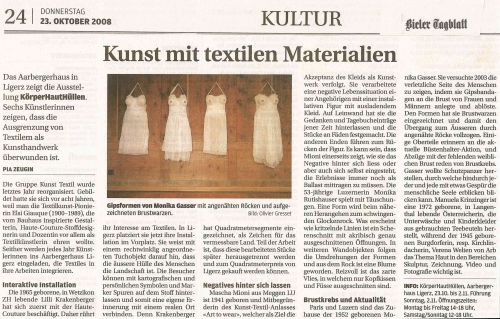
The Aarbergerhus in Ligerz shows the exhibition KörperHautHüllen; Mascha Mionis room-installation "Skins of Humanity"
Pia Zeugin writes in the Bieler Tagblatt: "...Mascha Mioni .... verarbeitete eine negative Lebensssituation einer Angehörigen mit einer installativen Figur mit ausladendem Kleid. Auf Leinwand hat sie die Gedanken und Tagebucheinträge jener Zeit hinterlassen und die Stücke an Fäden festgemacht. Die anderen Enden führen zum Rücken der Figur. Es kann sein, dass Mioni einerseits zeigt, wie sie das Negative hinter sich liess oder aber auch sich selbst eingesteht, die Erlebnisse immer noch als Ballast mittragen zu müssen. ..."
"...Mascha Mioni .... digested a negative experience of one of her relatives by installing a figure with a wide dress. She noted thoughts and diary-entries from that time on pages of linen and attached them with thread. The other ends lead to the back of the figure. Maybe she shows how she set the negative behind her or maybe she admits to herself, that she still has to carry these experiences with her. ..." (translation by the webmaster)
go to post
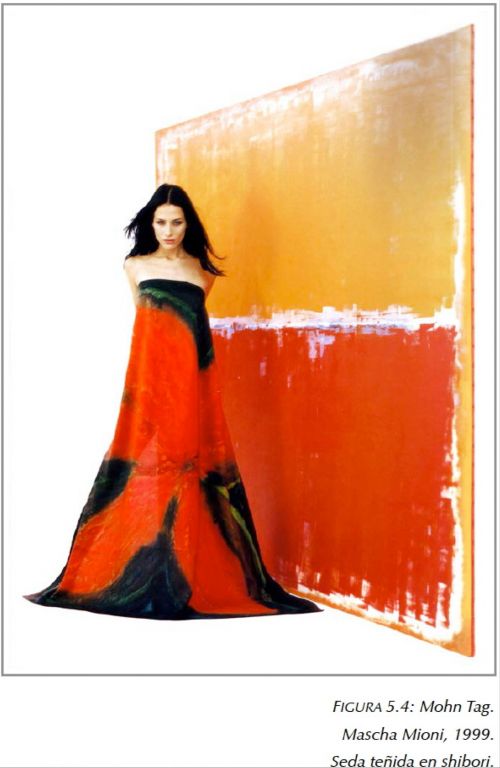
Angela Hurtada Pimentel - Bachelor of Fine Arts Arbeit
In ihrer Arbeit zum Bachelor of Fine Arts an der Universität von Costa RIca nimmt Angela Hurtado Pimentel das 1999 entstandene Werk "Mohn Tag" von Mascha Mioni als Beispiel für die Verbreitung Japanischer Shibori-Technik in die ganze Welt.
Quelle: DISEÑO DE VESTIDOS MODA PRENDAS DE VESTIR, S. 69;
Ganze Arbeit als pdf: